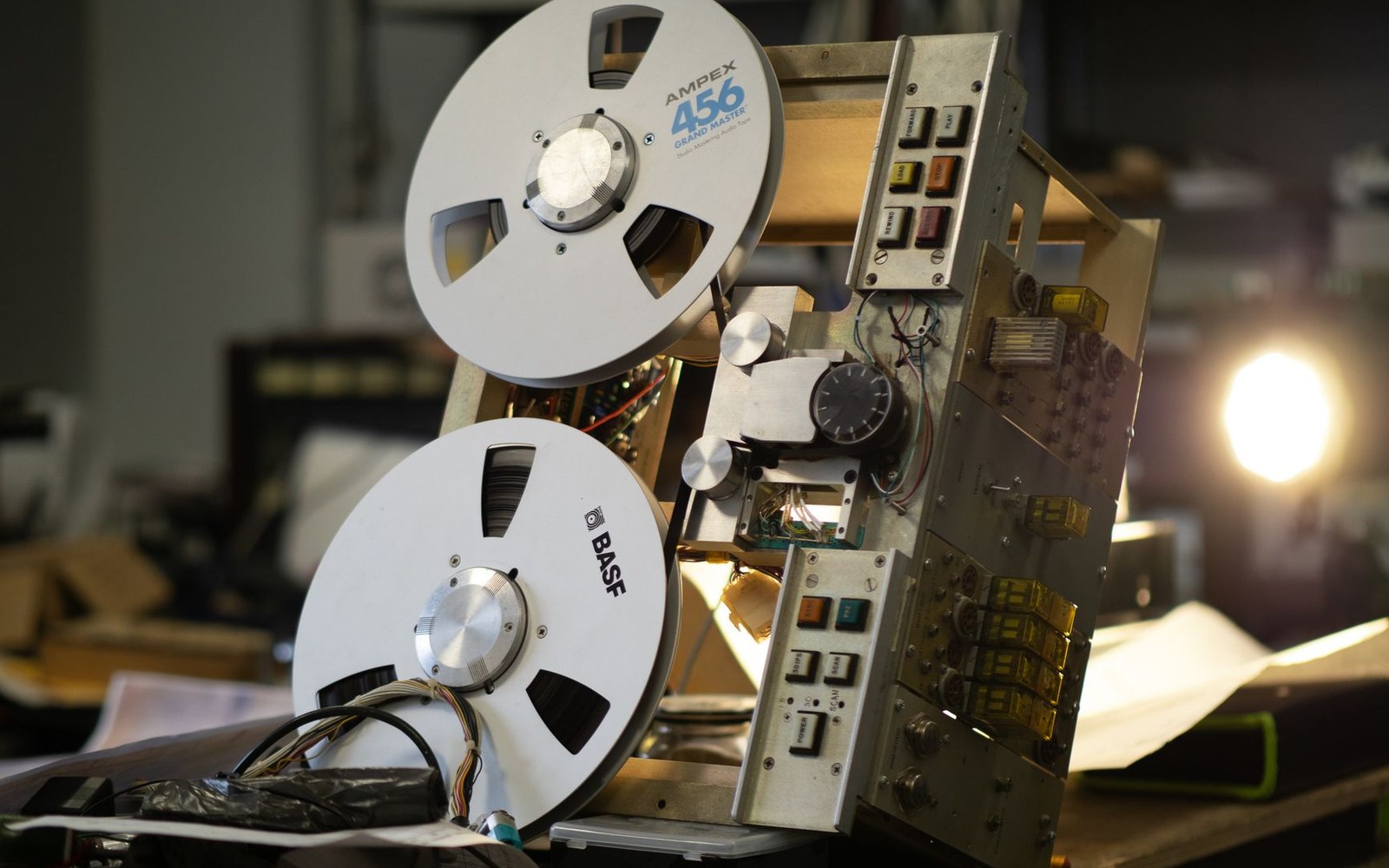

What Fails and Why
The capstan shaft and pinch-roller together form the tape-transport's primary drive mechanism: the rotating steel shaft pulls tape at a fixed speed while the rubber roller presses it against the shaft with enough friction to maintain contact. Both degrade with time, but they fail differently.
Rubber deteriorates through oxidative hardening regardless of use. A pinch roller that sat in a cupboard for twenty years is frequently harder than one that ran eight hours a day through the 1980s, because heat cycling and atmospheric ozone affect polymer chemistry independent of mechanical wear. Hard rubber loses grip; the tape slips intermittently against the capstan, producing the characteristic wavering pitch known as wow — a slow cycle — or flutter, which is faster and more erratic. Either makes the machine unrecordable and, for playback of anything pitch-sensitive, unusable.
Oxide accumulates on the capstan shaft from routine contact with the tape coating. Unlike head deposits, which every operator should clean regularly, capstan contamination builds up unevenly and can cause the tape to ride fractionally off-centre or stick momentarily against the shaft, interrupting the drive. On a worn machine, the two failure modes interact: a glazed roller combined with an oxidised capstan produces speed instability that varies with tape tension and playback load, making it difficult to isolate either cause without addressing both.
What a Technician Assesses at Intake
A technician quoting a restoration checks the pinch roller first by feel — a correctly conditioned roller yields under thumb pressure; a hardened one does not. Shore A durometer readings quantify this where the specification is known. Shaft runout is checked with a dial indicator against a tolerance that varies by machine design but is generally held to less than a few thousandths of an inch on broadcast-grade transports. Oxide deposits are evaluated visually and with a soft lint-free swab; embedded oxide that has migrated into surface pitting on the shaft is a stronger flag for shaft replacement than surface contamination alone.
Roller availability drives the quote more than labour. For common cassette-format machines and several open-reel platforms, new-old-stock and purpose-moulded replacements remain available through specialist suppliers. For less common transports, a roller must be remoulded — a process that adds cost and lead time. Shaft replacement on a quality open-reel machine requires the motor assembly to come out, which reframes the project's economics entirely.