The Instrument
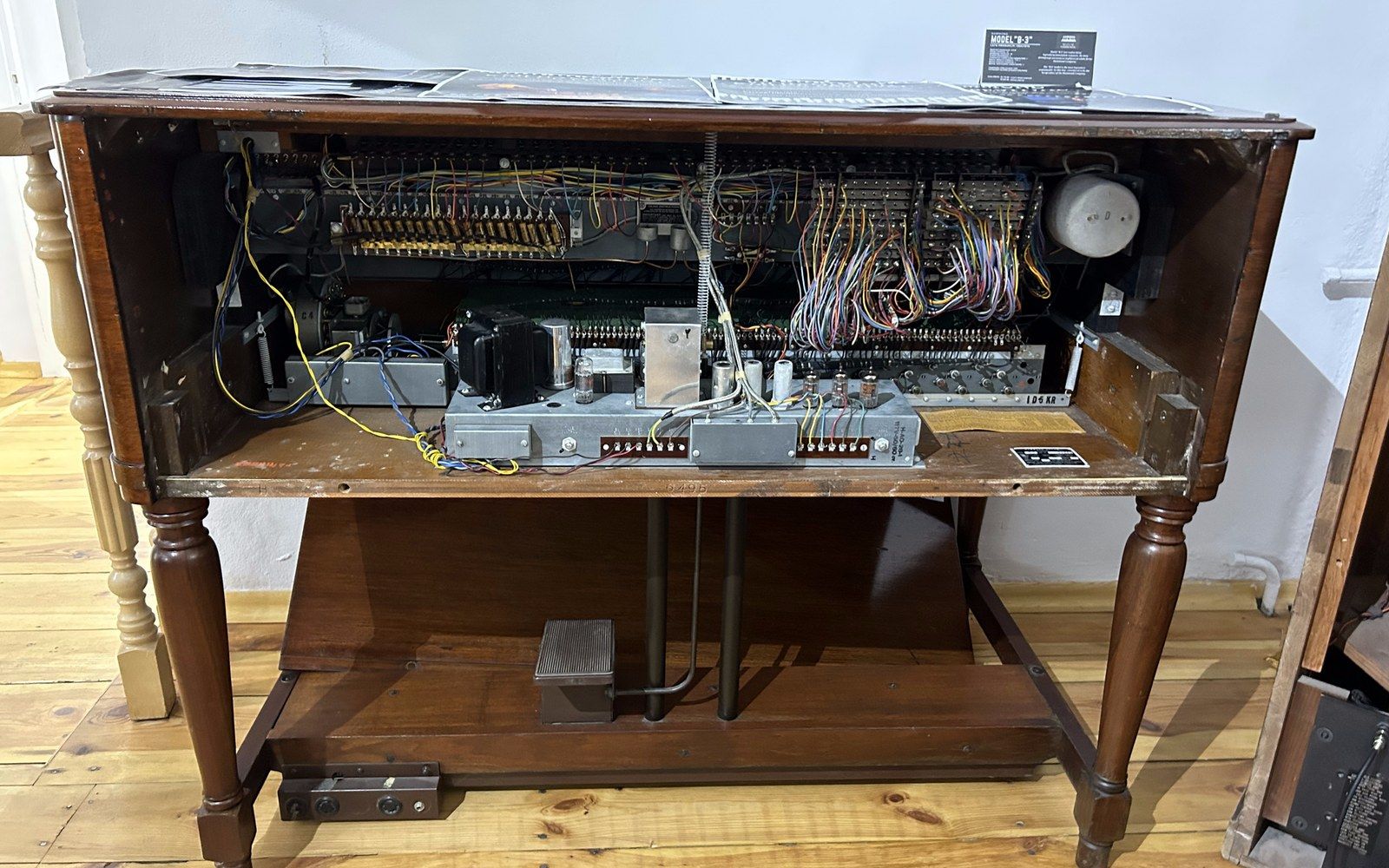
The B-3 arrived in 1954 as a refinement of the Model B introduced in 1935, sharing the same core mechanism: the tonewheel generator. Laurens Hammond's design spun ninety-one ferromagnetic wheels past electromagnetic pickups, each wheel's tooth count determining its pitch through a relationship between rotational speed and pickup frequency. No oscillators, no samples — pure electromechanical frequency generation, stable enough to hold pitch across a long service and quiet enough to install in a sanctuary without complaints about drift or buzz.
The drawbar system gave players additive timbral control in real time: nine bars per manual, each representing a harmonic partial (fundamental, octave, fifth, second harmonic, and so on), pulled out to mix levels from 0 to 8 in integer steps. The B-3 carried two sixty-one-key manuals and a thirty-two-note pedalboard. Combined drawbar settings number in the millions. In practice, players found a small number of configurations that worked and stayed close to them — the gospel-rooted 888000000 saturation, the slightly pulled-back settings for jazz comping, the solo voices in the upper partials.
What Hammond's engineers did not intend as a feature was key-click: the brief transient produced when a key contacts the bus bar, leaking a broadband noise burst into the audio path. Early Hammond technicians regarded it as a defect and corrected it where they could. Players learned to use it as attack articulation, and by the time circuit refinements might have eliminated it cleanly, the click was too embedded in the instrument's identity to remove. The B-3's percussion circuit, introduced on that model, added a fast-decaying second or third harmonic — a plucked front-end to the sustained drawbar tone — that reinforced the rhythmic vocabulary players were already building with click and touch.
The Cabinet Problem
Don Leslie built his first rotating speaker in 1941. The mechanism was conceptually simple: a rotating treble horn and a counter-rotating bass rotor inside a wooden cabinet, producing a Doppler-effect modulation — a chorus-and-vibrato interaction that the Hammond's own internal vibrato scanner could approximate but not replicate. Hammond offered its own vibrato circuit; it was not the same thing.
Hammond refused to distribute or endorse the Leslie cabinet, and for years actively discouraged dealers from pairing the two. Leslie filed his own patents and sold his cabinets independently, navigating a market in which the dominant keyboard manufacturer was functionally an adversary. The standard Leslie 122, running a tube amplifier into the dual-rotor assembly, became the pairing players demanded regardless of manufacturer preference. The slow-to-fast rotor speed change — controlled by a footswitch or a cable tap into the B-3's external output — gave performers the dynamic shift from sustained pad to spinning, urgent shimmer that became a structural element of the music itself.
- 1935Hammond Model B introduced
- 1941Don Leslie builds first rotating speaker prototype
- 1954Hammond B-3 introduced, adding percussion circuit
- 1965Hammond acquires Leslie Speaker Company
- 1975B-3 production ends
Hammond's position was commercially untenable. Players were buying Leslies whether Hammond approved or not, and technicians were cutting non-standard cables to make the connection work. CBS acquired the Leslie Speaker Company in 1965, at which point the cabinet moved from competitive product to integrated accessory. The 122 remained the standard model well into the B-3's production run, which ended in 1975.
What It Left Behind
Hammond discontinued the B-3 after twenty-one years of production. The used market absorbed the existing stock at prices that climbed for decades; a serviced, road-worthy B-3 with a matching 122 was already a significant purchase by the 1980s and has remained so. The instrument weighs roughly 195 kilograms fully rigged — a logistical argument that drove demand for lighter alternatives and eventually for digital recreations, none of which have fully displaced the original in the rooms where its sound is considered non-negotiable.
Hammond Suzuki, the current licence-holder following a corporate reorganisation in the 1980s, produces the B-3mk2 and the more compact XK series as digital instruments modelling the tonewheel behaviour and key-click characteristics. The tonewheel originals continue to circulate through technicians who understand the mechanism — lubrication schedules, tone generator cleaning, capacitor replacement in the Leslie amplifier section — as working instruments rather than museum objects.