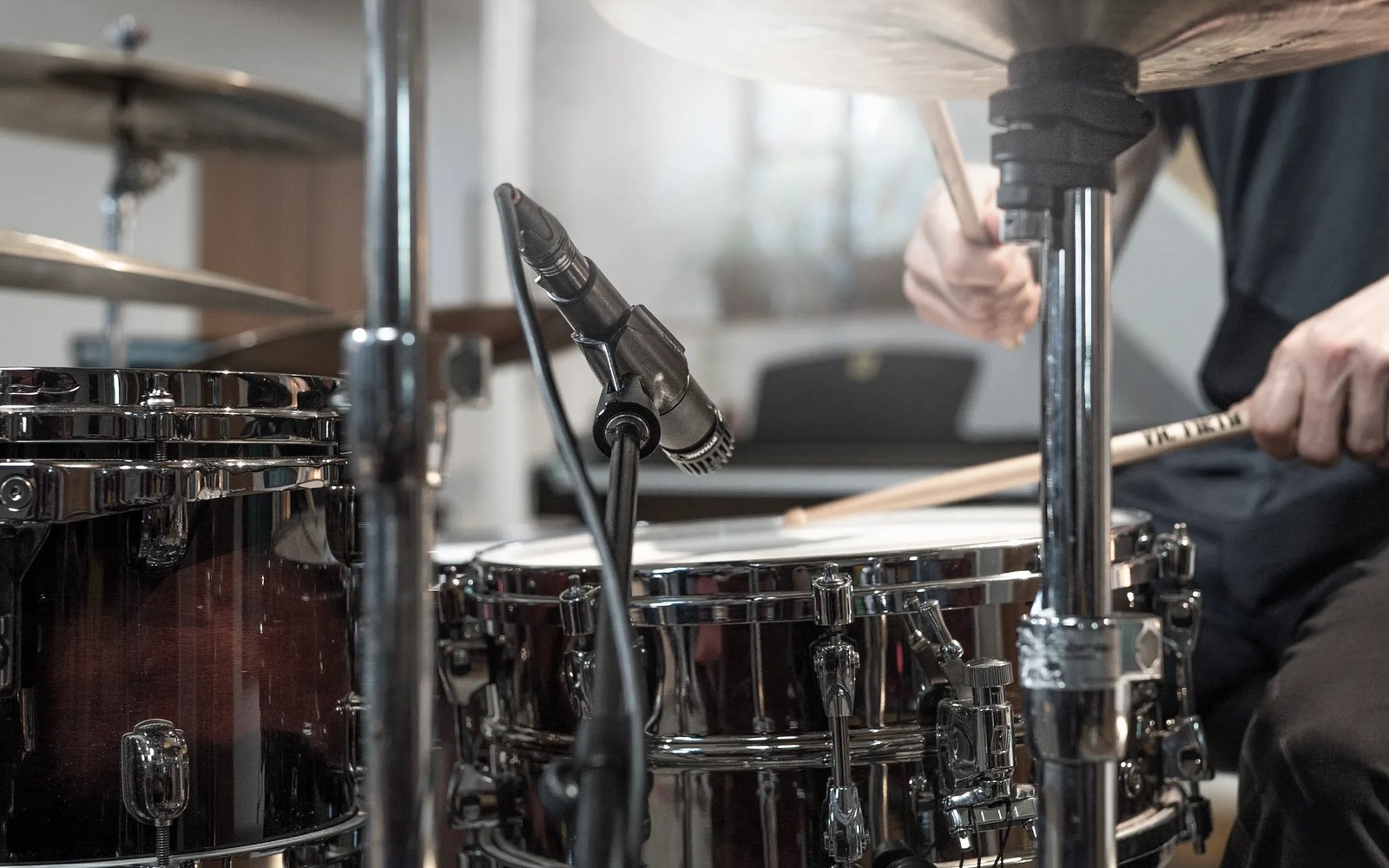

The Same Mic, Dressed Differently
The Shure SM57 (1965) and SM58 (1966) share the same Unidyne III moving-coil capsule — a cardioid dynamic element developed by Shure engineers in the early 1960s as a successor to the Unidyne II. The difference between the two models is not the transducer but what surrounds it. The SM58 wraps the capsule in a bulbous ball grille with an integrated windscreen, tuned toward the proximity effect that flatters a vocalist working close to the mic. The SM57 sits the same element closer to an open, low-profile grille, which preserves high-frequency transient detail and makes it the default choice for instrument sources — snare drums, guitar cabinets, brass.
Neither design has undergone a fundamental revision in sixty years. Shure has refined manufacturing tolerances, updated the paint and cosmetic detailing, and periodically revised the internal shock-mounting, but the Unidyne III capsule itself remains the core of both products. That continuity is not inertia; it is a calculated bet that has paid off in institutional adoption at a scale few audio products reach.

The White House Standard
The most-cited piece of documentary evidence for the SM57's durability is its specification on the White House press-room and podium installations. The Presidential podium has carried SM57s since at least the early 1980s, a specification that has survived administrations of both parties and every broadcast standard change in between. The Secret Service and White House Communications Agency list the SM57 by model number as the required podium microphone, a designation that functions as a public procurement certificate no marketing department could invent.
On stage and in studios, the logic is the same: the SM57 and SM58 are specified by name on riders, in venue infrastructure documents, and in studio outfitting lists — not because engineers lack alternatives, but because their predictability removes a variable. A touring engineer picking up a rental package in any major city on any continent expects SM57s in the drum case and SM58s at the vocal stands. That expectation is, by now, self-reinforcing. Reliability became ubiquity, and ubiquity became specification.
Sixty years of that cycle is a product life that essentially no other piece of audio hardware matches without either obsolescence or reinvention. The SM57 and SM58 achieved neither.