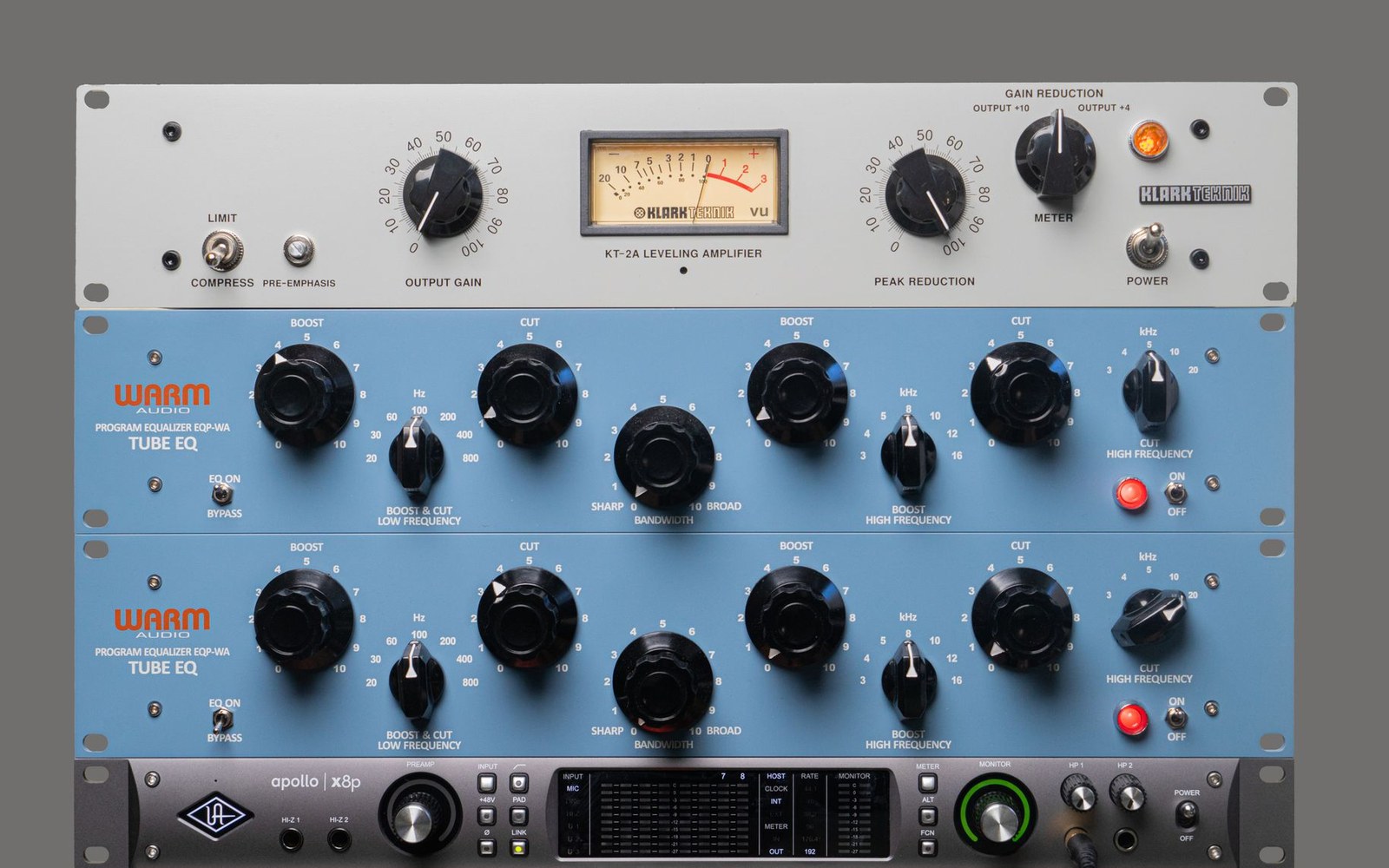

The Circuit and What It Did
Rupert Neve designed the 1073 module for the 80-series console in 1970, and the topology has not been fundamentally improved upon since. The input stage runs class-A throughout, with hand-wound Marinair transformers on both input and output — the iron is integral to the sound, not incidental to it. A discrete transistor amplifier drives a three-band EQ section offering shelving filters at 35 Hz and 12 kHz and a midrange peak selectable across six frequencies from 360 Hz to 7.2 kHz. Gain is switched, not continuous, which disciplines the circuit and the engineer in equal measure.
The combination of transformer saturation and class-A bias produces the characteristic — a warmth in the low-mids and a top-end air that solid-state designs without output iron consistently fail to replicate. Every subsequent solid-state preamp that claims "musicality" or "analogue warmth" is being measured, consciously or not, against what Rupert Neve built in that module.
Where the Originals Went
The 80-series consoles carrying 1073 modules entered the major studios of the early 1970s. Wessex Sound Studios in London installed an early unit; AIR Studios, founded by George Martin, ran an 8078 — the large-format sibling using the same module family. Island Records' Basing Street facility in London housed one, as did Olympic Sound Studios. These rooms tracked the defining British records of the decade, and the 1073's sonic character is embedded in those recordings by simple physical fact.
Reissue and the Afterlife
Neve's original company changed hands through the 1980s and 1990s before the 1073 was reissued as a standalone unit. AMS Neve — the current steward — produces the 1073 as a discrete outboard module and in rack-format versions. Warm Audio, BAE Audio, and Chandler Limited all manufacture variants or close approximations; each acknowledges the 1073 circuit as the explicit target. Universal Audio has modelled it in plugin form. That none of these fully displace the original in serious A/B tests is the most reliable testimony to what Neve solved in 1970.