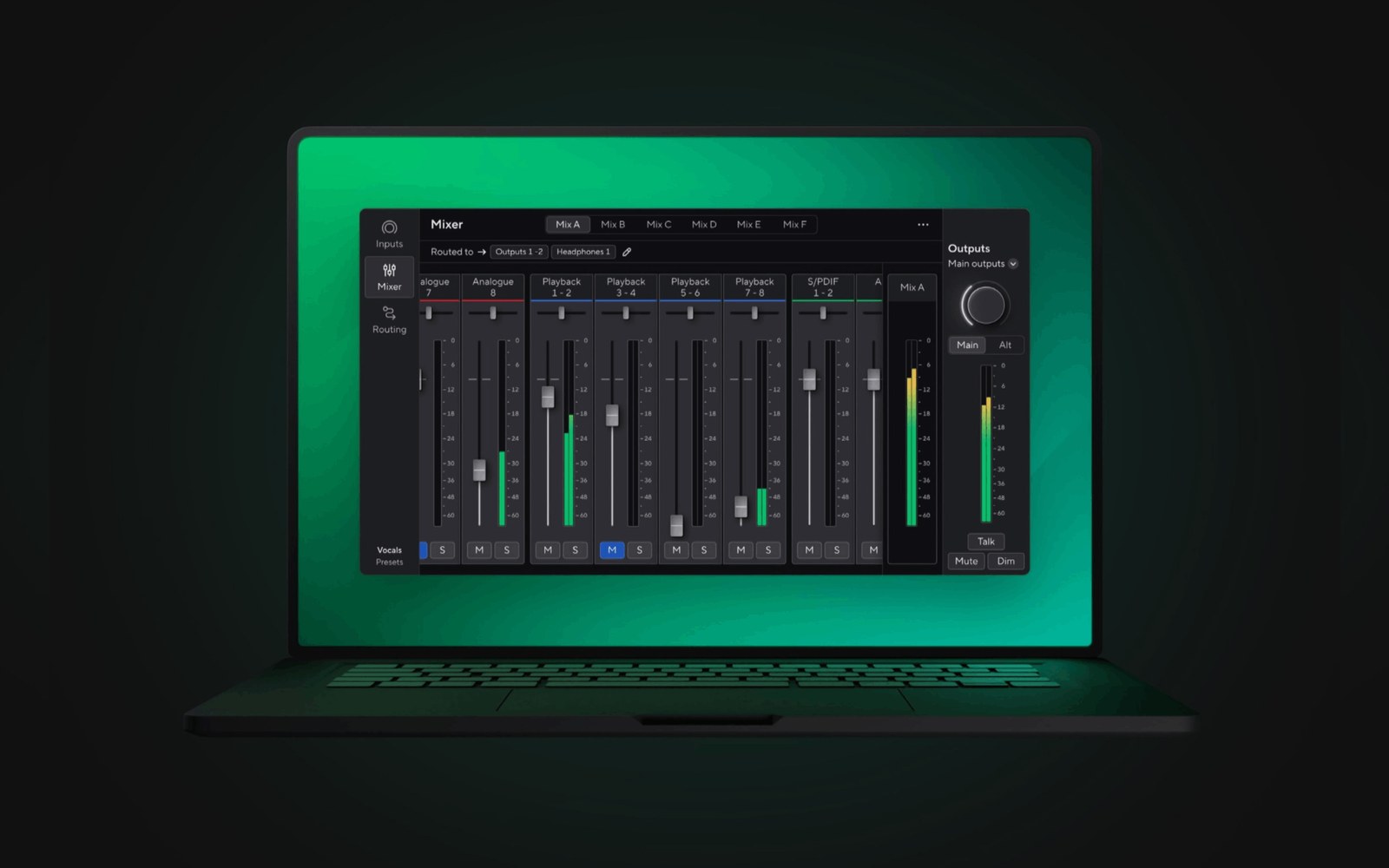

A Red Box at Every Price Point
Focusrite launched the Scarlett series in 2011, targeting the growing home-recording market with USB interfaces built around the company's preamp heritage — a lineage running back to Rupert Neve's original Focusrite console designs. The 2i2, a two-in, two-out unit aimed at bedroom producers and podcasters, became the series' anchor product almost immediately. By the third generation (2019) and fourth (2021), it had accumulated enough platform dominance that Focusrite plc's annual reports consistently cited the Scarlett range as the primary revenue driver for the consumer audio segment.
The reasons are structural rather than spectacular. The 2i2 offered 48V phantom power, a direct monitor switch, and clean-enough preamps at a price point that made hesitation irrational. Each revision addressed the previous generation's weaknesses without drifting upmarket: the third generation improved headroom and added Air mode — a high-frequency lift modelling the transformer characteristic of a vintage ISA preamp — and the fourth added revised converters and better clipping performance. Nothing flashy, nothing removed. The interface that a music-technology lecturer recommends in September stays the recommended interface in March, and that word-of-mouth stability is extremely difficult to dislodge.
Sweetwater's bestseller charts and Amazon's audio interface category have reflected the 2i2's position at or near the top consistently enough that its presence there now operates as self-reinforcing social proof. Teachers recommend it; students buy it; those students later become the teachers. The loop is closed.
What Universal Audio Offered Instead
Universal Audio's answer to the entry-level question was the Volt series, introduced in 2021 — compact USB-C interfaces with an analogue Vintage preamp mode, plus a built-in 1176-style compressor on the larger Volt 276 and 476. The Volt 1 and Volt 2 positioned themselves as sonically differentiated rather than cheaper, and they are: the vintage mode adds transformer-style harmonic character that the Scarlett's cleaner topology does not replicate.
But that differentiation targets a buyer who already understands what the 1176 does. UA's Apollo range — DSP-equipped interfaces running UAD plug-ins at tracking latency — addresses a genuinely different tier: studio operators who need processing on the way in, not after. The Apollo's price point, typically several times that of a Scarlett, reflects the onboard DSP rather than just the conversion.
The Scarlett 2i2 occupies a category that neither Volt nor Apollo displaces: the first interface, bought without prior knowledge, recommended without qualification. That market segment is enormous, and Focusrite still owns it.